

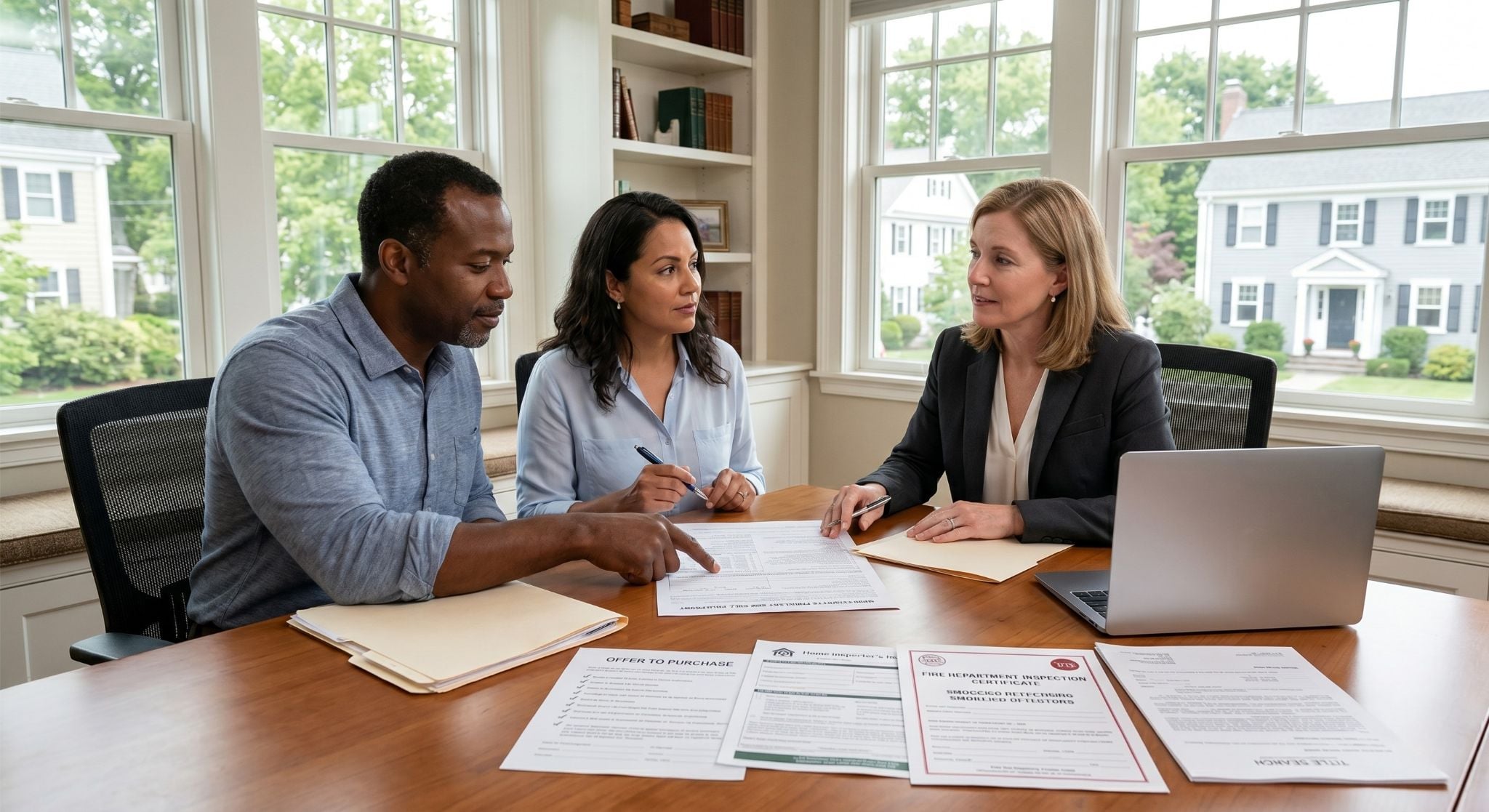
What to expect after your offer is accepted in Massachusetts.
In Massachusetts, an accepted offer begins a two-contract process: the Offer to Purchase (OTP) is followed by the attorney-drafted Purchase and Sale Agreement (P&S), signed 10 to 14 days later. Buyers complete a home inspection within 7 to 10 days, submit a second deposit at P&S signing totaling 5% of the purchase price, and work through lender underwriting before an attorney-conducted closing. Pre-closing requirements unique to Massachusetts include a smoke and carbon monoxide detector certificate and, for homes with private septic, a Title V inspection. The full process typically takes 4 to 8 weeks.
By John Hollis | May 26, 2026
Getting your offer accepted in Greater Boston feels like crossing the finish line. It's not. It's more like reaching the starting line of the real race.
Massachusetts has one of the most structured real estate transaction processes in the country. Two separate contracts. A mandatory attorney review. A home inspection you can no longer waive. A smoke and carbon monoxide certificate from your local fire department. And in many cases, a septic inspection called a Title V. If your offer just got accepted, here's exactly what happens next, and when.
The Offer to Purchase: Your First Contract
In Massachusetts, most residential transactions begin with an Offer to Purchase, commonly called an OTP. This is a binding contract, but shorter and less detailed than what comes next. It establishes the purchase price, the property address, your target closing date, and the contingencies you're relying on, typically inspection, financing, and appraisal.
When you sign the OTP, you'll submit your first earnest money deposit. This usually runs between $1,000 and $5,000, depending on the deal and what was negotiated. The deposit is held in escrow, typically by the listing broker.
The OTP gives you time to complete your inspection and review the property before you're locked in at a deeper level. That inspection window is usually 7 to 10 days from acceptance.
The Inspection Period
As of October 15, 2025, Massachusetts law prohibits sellers and their agents from conditioning offer acceptance on a buyer waiving the home inspection. The inspection pressure of the 2021-2022 market is now illegal, not just inadvisable.
Use this window fully. A licensed home inspector walks the property and provides a written report covering the foundation, roof, heating, electrical, and plumbing systems. The report is your negotiating tool. In Massachusetts, you can use the inspection results to request repairs, ask for a price reduction, or, if the issues are genuinely serious, walk away with your deposit.
If you walk during the inspection contingency period with clean contract language, your OTP deposit is typically returned. This is one reason having an experienced agent matters more than most buyers expect.
How to Win in a Competitive Greater Boston Real Estate Market
The Purchase and Sale Agreement: The Real Contract
Once the inspection is resolved, both sides move to the Purchase and Sale Agreement, the P&S. The P&S is drafted by attorneys, not by the agents. This is what makes Massachusetts different from most states. Your attorney reviews title, drafts and negotiates the agreement's language, and represents your interests through closing.
You'll typically sign the P&S within 10 to 14 days of the accepted OTP, though timelines vary based on inspection negotiations and attorney schedules.
At the P&S signing, you submit your second deposit, usually bringing your total escrow to 5% of the purchase price. On an $800,000 home, you're putting roughly $40,000 into escrow at this stage, minus whatever you put in at the OTP. This money is held by the seller's attorney until closing.
The P&S locks in your closing date, finalizes contingencies, and establishes your rights if something changes between now and the table. Your attorney will walk you through all of it. Ask every question you have.
Financing and the Appraisal
After the P&S is signed, your lender orders the appraisal. The appraisal determines whether the bank believes the home is worth what you've agreed to pay. If the appraisal comes in low, your options depend on how your P&S was written. You can renegotiate the price, cover the gap in cash, or exit under your financing contingency. None of those conversations are easy.
Your lender will typically issue a mortgage commitment letter three to four weeks after the P&S is signed. That letter confirms the lender's agreement to fund your loan as long as nothing material changes before closing.
This is a critical window. Don't make large purchases, switch jobs, open new credit accounts, or do anything that changes your debt-to-income ratio. Lenders re-verify your finances close to the closing date.
Massachusetts-Specific Requirements Before Closing
A few steps happen in the weeks before your closing that buyers coming from out of state rarely expect.
Smoke and carbon monoxide detector certificate. The seller must schedule an inspection with the local fire department to confirm the home's smoke and CO detectors comply with Massachusetts law. The fire department issues a certificate, and the seller pays for it. If detectors don't pass, the seller must update them before closing.
Title V septic inspection. If the property uses a private septic system rather than municipal sewer, the seller must provide a passing Title V inspection from a licensed inspector. A passing certificate is valid for two years (or three years if the system was pumped annually with documentation). If the system fails, the seller is responsible for remediation, which can range from a few thousand dollars to over $50,000 for a full replacement.
6(d) certificate for condominiums. If you're buying a condo, the seller must obtain a 6(d) certificate from the condo association confirming the unit has no outstanding fees, assessments, or charges. The certificate must be current at closing. Associations typically take 3 to 10 business days to produce one.
Final water and sewer reading. Many municipalities require a final water and sewer reading before closing so the seller's account can be settled accurately and the new owner starts clean.
The Final Walkthrough
Within 24 to 48 hours of your scheduled closing, you have the right to do a final walkthrough of the property. Use it. Confirm the home is in the agreed-upon condition, that any negotiated repairs were completed correctly, and that the sellers have vacated.
If something isn't right at the walkthrough, contact your attorney immediately.
Things You Shouldn't Do When Buying a Home
The Closing
Massachusetts is an attorney-only closing state. A licensed real estate attorney must be present and conduct the closing. Buyers sign mortgage documents, the deed transfer paperwork, and the final Closing Disclosure.
You'll bring the remainder of your down payment and closing costs via wire transfer or certified check. Buyer closing costs in Massachusetts typically run 2% to 4% of the purchase price. On an $800,000 home, plan for $16,000 to $32,000 in closing costs on top of your down payment.
After signing, the attorney records the deed at the Registry of Deeds. Once it's recorded, you get the keys.
One More Step After Closing: Your Homestead Declaration
After closing, file a Declaration of Homestead at the Registry of Deeds. As of August 2024, filing provides up to $1,000,000 in equity protection for your primary residence against most unsecured creditor claims. The filing fee is approximately $35, and all owners need to sign in front of a notary.
It takes about 30 minutes and protects more equity than most people realize. Every buyer should handle this in the first week after moving in.
From accepted offer to closing, a typical Greater Boston transaction takes four to eight weeks. The more organized your team is going in, the smoother the process goes on the other end.
Frequently Asked Questions
How long does it take to close on a house in Massachusetts after an offer is accepted?
Most Massachusetts transactions close four to eight weeks after the offer is accepted. The timeline includes the inspection period, Purchase and Sale Agreement drafting and signing, appraisal, mortgage underwriting, and final walkthrough. If the inspection negotiation is smooth and financing is already well underway, four to five weeks is achievable.
What is the difference between an Offer to Purchase and a Purchase and Sale Agreement in Massachusetts?
The Offer to Purchase (OTP) is the initial binding contract that establishes the price, closing date, and key contingencies. The Purchase and Sale Agreement (P&S) is the more detailed, attorney-drafted contract signed 10 to 14 days later. The P&S governs the transaction through closing and is the document your attorney negotiates most carefully on your behalf.
Can a buyer back out after signing the Purchase and Sale Agreement in Massachusetts?
It depends on the contingencies in your P&S. If you have a financing contingency and your loan falls through despite good-faith efforts, you can typically exit and recover your deposit. If you walk without a contractual basis, you risk forfeiting your 5% deposit. Your attorney will explain exactly what your exit rights are based on your specific P&S language.
Who pays for the smoke and CO certificate in Massachusetts?
The seller is responsible for obtaining and paying for the smoke and carbon monoxide detector certificate in Massachusetts. The seller schedules the inspection with the local fire department before closing. If the detectors don't pass, the seller must bring them into compliance before the transaction can close.
What is a Homestead Declaration in Massachusetts and do I need to file one?
A Homestead Declaration is a document you file at the Registry of Deeds after purchasing a primary residence in Massachusetts. Filing provides up to $1,000,000 in equity protection against most unsecured creditor claims. The filing fee is approximately $35. Every buyer should file it within the first week after closing. It costs almost nothing and protects a significant amount of your equity.
Getting from accepted offer to closing in Massachusetts is more involved than most buyers expect, especially if you're coming from another state. The process is well-defined, and every step has a purpose.
If you're working through this for your own situation, we're happy to talk it through. Reach out to John Hollis Group at 617-431-1826 or visit johnhollisgroup.com.
About John Hollis
John Hollis is a Senior Real Estate Advisor and founder of John Hollis Group at Amo Realty, serving buyers and sellers across Greater Boston and surrounding Massachusetts for over 20 years. His team brings market insight, precise preparation, and strong advocacy to every transaction, from Boston to the North Shore, South Shore, MetroWest, and Southeastern Massachusetts.
Check out this article next